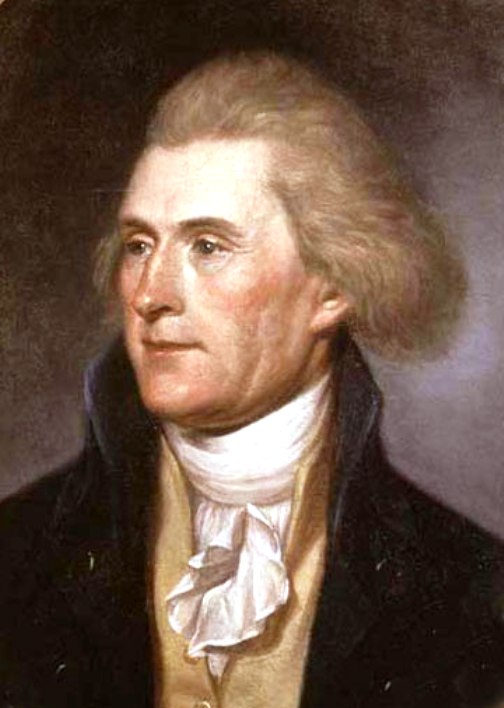
Showing posts with label Jefferson. Show all posts

Monday, January 6, 2014

HUMBOLDT & JEFFERSON'S NOTES

AM | @HDI1780


"Before being free, it is necessary to be just" — Alexander von  Humboldt

The Humboldt-Jefferson relationship can be studied from many different angles: the value of Humboldt's information about Mexico (including his much sought-after maps), the interpretation of the revolutions in South America, the degeneracy controversy (which involved Raynal), and so on (*). A minor, but interesting, aspect of that story is the eagerness with which Humboldt tried to obtain a copy of Jefferson's Notes on the State of Virginia. (That eagerness was shared by at least two contemporaries: Volney and Mariano Moreno — more on that in coming weeks.)

* * *

In September 1810, Humboldt —deeming himself short-changed by the Americans in terms of the exchange of information that took place in the spring of 1804— begged the retired U.S. president to send him a copy of the Notes: "Je reïtere ma priere, de recevoir, en cadeau, de Votre main, Votre ouvrage sur la Virginie. Je le possède depuis 15 ans, mais je voudrois pouvoir montrer à mes amis un exemplaire dans lequel Vous aviez écrit que Vous me le donnez. C’est a quoi aspire ma vanité et je ne m’en defends pas" [see].

But what did he really mean by "Je le possède depuis 15 ans"? In the third volume of his Essai politique sur la Nouvelle-Espagne, the Prussian scientist mentions Jefferson in the context of the degeneracy controversy: "Cette réfutation se trouve dans l'excellent ouvrage de M. Jefferson sur la Virginie, p.109-166" [see]. Mystery solved! Pages 109-166 correspond not to the original version of the Notes, but to André Morellet's translation, published in early 1787 and recently digitized by Google Books [see]:

OBSERVATIONS

SUR

LA VIRGINIE

PAR M. J***

TRADUITES DE L'ANGLOIS

A PARIS

Chez BARROIS, l'aîné, Libraire, rue du

Hurepoix, près le pont Saint-Michel
_______________

1786

What Humboldt so eagerly desired was the original, English version of the Notes, autographed by its author. In the end, Jefferson relented; in yet another memorable document (TJ's April 1811 letter on South American revolutions), he writes: "In sending you a copy of my Notes on Virginia, I do but obey the desire you have expressed. They must appear chetif enough to the author of the great work on South America. But from the widow her mite was welcome, and you will add to this indulgence the acceptance of my sincere assurances of constant friendship and respect."

It was only in December of that year that Humboldt could aknowledge the arrival of the much coveted book:

Monsieur,

J’arrive hier de Vienne où mon frere est Ministre du Roi de Prusse et ou j’ai passé un mois pour voir mes parents. J’ai eté bien heureux de retrouver à mon retour l’interessante lettre que Vous avez daigné m’écrire, Monsieur, et que Vous avez accompagné d’un cadeau auquel je mets le plus grand prix. Les notes sur la Virginie seront placeés dans la bibliotheque que nous avons formé mon frere et moi. c’est un titre de gloire pour moi que d’avoir joui de la bienveillance, j’ose dire de l’amitié d’un homme qui a etonne ce siecle par ses vertus et sa moderation.


Affaire à suivre !

(*) The starting point here is the masterful piece by H. R. Friis: "Alexander von Humboldts Besuch in den Vereinigten Staaten von Amerika. Vom 20. Mai bis zum 20. Juni 1804", in Joachim H. Schultze (ed.) Alexander von Humboldt. Studien zu seiner universalem Geisthaltung. Berlin: Verlag Walter de Gruyter & Co., 1959, pp. 142-195.
________________

Wednesday, July 18, 2012

TWEETING HISTOIRE DES DEUX INDES
"On les attaqua dans leurs isles" — Raynal

AM | @HDI1780

So far, Histoire des deux Indes's Twitter account (@HDI1780) has produced only mixed results. Let's start with the bad news. Although I am tweeting on a regular basis, and although I try to follow more and more people, I have only ... 27 followers. The truth is that Raynal, Diderot, Deleyre, and the magic world of Histoire des deux Indes do not seem to attract many people online. But there is a silver lining in the midst of difficulty. Tweeting Raynal is forcing me to re-read the whole work — which yields new discoveries on an almost daily basis. (The same happens with the blog: the more I blog, the more my book becomes obsolete with respect to my own subsequent findings!)

* * *

I started tweeting Book X because I have Books X-XIX in plain text format, which simplifies everything. (If all goes according to plan, I will start with Book I after the August break). Raynal's writing lends itself pretty well to the task: most of his sentences can be divided into chunks of 140 characters without really altering their meaning. Generally speaking, it is better to tweet a chapter starting from the bottom sentences, so that readers can have a clear sense of the text. (But this is only possible in relatively short chapters). Anyway, here's my takeaway on what I have tweeted so far from Book X:

. "Quelque fâcheux que soient ces effets naturels de la pluie, elle en occasionne de plus redoutables encore: ce sont des tremblemens de terre assez fréquens..." (x.5). Earthquakes are discussed within a scientific framework — there are no references to God or destiny. The same principle applies to hurricanes. See the second chapter of Jonathan Israel. Democratic Enlightenment. Philosophy, Revolution, and Human Rights, 1750-1790 (New York: Oxford University Press, 2011), pp. 682-683 [info].

. "... l’ordre constant qui pourvoit à la régénération par la destruction même..." (x.5). Did Joseph Schumpeter read Histoire des deux Indes? I think so. This looks a lot like the Austrian economist's most celebrated phrase about creative destruction — more on that soon on the blog.

. "La religion, les loix, les échafauds, ces digues par-tout élevées pour garantir les usurpations anciennes contre les usurpations nouvelles..." (x.6). The digue metaphor, common to Montesquieu and Helvétius.

. "Le vol ne fut connu de ces sauvages, qu’à l’arrivée des Européens" (x.6). One of my very few re-tweets! There is an emerging rousseaunian tone here: "Les Caraïbes qui n’avoient pas le cœur gâté par les mauvaises institutions qui nous corrompent, ne connoissoient ni les infidélités, ni les trahisons, ni les parjures, ni les assassinats, si communs chez les peuples policés".

. "Jamais il ne leur échappoit aucune attention, aucune démonstration de tendresse, pour ce sexe si recherché dans d’autres climats" (x.6). Now we part company with Rousseau, only to revisit De Pauw's views on human degeneracy in the New World. The lack of sexual desire is an unmistakable sign of degeneracy. See Jonathan Camio: « L'abbé Raynal et la Dispute du Nouveau Monde: le cas de l'Histoire des deux Indes », in Gilles Bancarel (ed.) Raynal et ses réseaux. Paris: Honoré Champion, 2011 [info], pp. 307-319.

. "Ils regardoient leurs femmes plutôt comme leurs esclaves que comme leurs compagnes" (x.6). On the situation of women in Indian tribes: "[Ils] ne leur permettoient pas de manger avec eux, & avoient usurpé le droit de les répudier, sans leur laisser celui de changer d’engagement".Thomas Jefferson was a careful reader of these passages [see].

. "Le goût de la domination n’affectoit guère l’ame des Caraïbes. Sans distinction de rang, ils étoient tous égaux" (x.6). A key theme throughout Histoire des deux Indes: Raynal complains against the tyranny of rank and aristocracy. See also: "Leur surprise fut extrême, lorsqu’ils remarquèrent de la subordination entre les Européens." This point is well analyzed by Jonathan Israel.

. "Chaque famille composoit une espèce de république séparée, jusqu’à un certain point, du reste de la nation" (x.6). Raynal applies the langage of modern politics —république, nation— to the simple world of Caraïbes. Jefferson would do much the same thing in his Notes on the State of Virginia [see]. A separated republic! Music to Jefferson's ears!

. "Les pirates qui, suivant les préjugés de cette couronne, avoient usurpé une de ses possessions..." (x.7). See also: "[L'alliance] n'emportoit point d’engagement durable, encore moins de garantie des possessions réciproques". The bourgeois ideal — the stability of possession and property as one of the hallmarks of Histoire des deux Indes.

. "A cette époque, les établissemens Anglois qui, sous un gouvernement supportable quoique vicieux, avoient acquis quelque consistance" (x.8). The notion of mixed government rebuffed [see].
______________

Wednesday, May 30, 2012

THE DECLARATION OF INDEPENDENCE: RAYNAL & JEFFERSON (PART V)
"Contrée héroïque, mon âge avancé ne me permet pas de te visiter..." — Raynal

AM | @HDI1780

In his gripping historical novel Waffen für Amerika (1946), Lion Feuchtwanger describes Beaumarchais' euphoric demeanour as he introduces the American Declaration of Independence into Parisian salons. Although his friends warn him that Benjamin Franklin "is not quite as optimistic as you are", an undeterred Beaumarchais sees the Declaration as the signal to move forward with his risky American ventures. The momentous events take place just as Raynal and Diderot sit down to write about events in North America for what would become the third edition of Histoire des deux Indes.

* * *

Chapter 45 of Book XVIII contains a partial translation of the Declaration of Independence. While the Declaration is deemed the Revolution's manifeste, its main author is not mentioned — a fact that must have contributed to Thomas Jefferson's enduring animosity towards Raynal. Here's the translation:

...l’histoire de la nation Angloise & de son roi n’offrira à l’avenir qu’elle entretiendra d’eux & de nous, qu’un tissu d’outrages & d’usurpations qui tendoient également à l’établissement d’une tyrannie absolue dans ces provinces.

The history of the present King of Great Britain is a history of repeated injuries and usurpations, all having in direct object the establishment of an absolute Tyranny over these States.
_______

Elle dira que son monarque a refusé son consentement aux loix les plus salutaires & les plus nécessaires au bien public.

He has refused his Assent to Laws, the most wholesome and necessary for the public good.
_______

[not translated]

He has forbidden his Governors to pass Laws of immediate and pressing importance, unless suspended in their operation till his Assent should be obtained; and when so suspended, he has utterly neglected to attend to them.

He has refused to pass other Laws for the accommodation of large districts of people, unless those people would relinquish the right of Representation in the Legislature, a right inestimable to them and formidable to tyrants only.
_______

Qu’il a transféré les assemblées dans des lieux incommodes, éloignés des archives, pour amener plus aisément les députés à ses vues.

He has called together legislative bodies at places unusual, uncomfortable, and distant from the depository of their public Records, for the sole purpose of fatiguing them into compliance with his measures.
_______

Qu’il a plusieurs fois dîssous la chambre des représentans, parce qu’on y défendoit avec fermeté les droits des peuples.

He has dissolved Representative Houses repeatedly, for opposing with manly firmness his invasions on the rights of the people.
_______

Qu’il a laissé, après cette dissolution, les états trop long-tems sans représentans, & par conséquent exposés aux inconvéniens résultant du défaut d’assemblée.

He has refused for a long time, after such dissolutions, to cause others to be elected; whereby the Legislative powers, incapable of Annihilation, have returned to the People at large for their exercise; the State remaining in the mean time exposed to all the dangers of invasion from without, and convulsions within.
_______

Qu’il s’est efforcé d’arrêter la population, en rendant la naturalisation des étrangers difficile, & en vendant trop cher les terreins dont il accordoit la propriété.

He has endeavoured to prevent the population of these States; for that purpose obstructing the Laws for Naturalization of Foreigners; refusing to pass others to encourage their migrations hither, and raising the conditions of new Appropriations of Lands.
_______

[not translated]

He has obstructed the Administration of Justice, by refusing his Assent to Laws for establishing Judiciary powers.
_______

Qu’il a trop mis les juges dans sa dépendance, en statuant qu’ils ne tiendroient que de lui, & leurs offices, & leurs salaires.

He has made Judges dependent on his Will alone, for the tenure of their offices, and the amount and payment of their salaries.
_______

Qu’il a créé des places nouvelles & rempli ces régions d’une multitude d’employés qui dévoroient notre substance & troubloient notre tranquillité.

He has erected a multitude of New Offices, and sent hither swarms of Officers to harrass our people, and eat out their substance.
_______

Qu’il a maintenu, en pleine paix, au milieu de nous des forces considérables, sans le consentement du pouvoir législatif.

He has kept among us, in times of peace, Standing Armies without the Consent of our legislatures.
_______

Qu’il a rendu le pouvoir militaire indépendant de la loi civile & même supérieur à elle.

He has affected to render the Military independent of and superior to the Civil power.
_______

Qu’il a tout combiné avec des hommes pervers, pour loger dans nos maisons des gens de guerre armés, & les mettre à couvert des peines dues aux meurtres qu’ils pourroient commettre en Amérique; pour détruire notre commerce dans toutes les parties du globe; pour nous imposer des taxes sans notre aveu; pour nous priver, dans plusieurs cas, de nos jugemens par jurés; pour nous transporter & nous faire juger au-delà des mers; pour nous enlever nos chartes, supprimer nos meilleures loix, altérer le fonds & la forme de notre gouvernement; pour suspendre notre propre législation & pouvoir nous donner d’autres loix.

He has combined with others to subject us to a jurisdiction foreign to our constitution, and unacknowledged by our laws; giving his Assent to their Acts of pretended Legislation:
For Quartering large bodies of armed troops among us:
For protecting them, by a mock Trial, from punishment for any Murders which they should commit on the Inhabitants of these States:
For cutting off our Trade with all parts of the world:
For imposing Taxes on us without our Consent:
For depriving us in many cases, of the benefits of Trial by Jury:
For transporting us beyond Seas to be tried for pretended offences
For abolishing the free System of English Laws in a neighbouring Province, establishing therein an Arbitrary government, and enlarging its Boundaries so as to render it at once an example and fit instrument for introducing the same absolute rule into these Colonies:
For taking away our Charters, abolishing our most valuable Laws, and altering fundamentally the Forms of our Governments:
For suspending our
own Legislatures, and declaring themselves invested with power to legislate for us in all cases whatsoever.
_______

Qu’il a lui-même abdiqué son gouvernement dans les provinces Américaines, en nous déclarant déchus de sa protection & en nous faisant la guerre.

He has abdicated Government here, by declaring us out of his Protection and waging War against us.
_______

Qu’il a fait ravager nos côtes, détruire nos ports, brûler nos villes, massacrer nos peuples.

He has plundered our seas, ravaged our Coasts, burnt our towns, and destroyed the lives of our people.
_______

[order altered here] Que dans ce moment il arrivoit sur nos plages des armées mercenaires & étrangères, chargées de consommer l’ouvrage de la désolation & de la mort. Et qu’un prince, dont le caractère fut ainsi marqué par tous les traits de la tyrannie, n’étoit pas fait pour gouverner un peuple libre.

He is at this time transporting large Armies of foreign Mercenaries to compleat the works of death, desolation and tyranny, already begun with circumstances of Cruelty & perfidy scarcely paralleled in the most barbarous ages, and totally unworthy the Head of a civilized nation.
_______

Qu’il a forcé nos concitoyens, faits prisonniers en pleine mer, à porter les armes contre leur patrie, à devenir les bourreaux de leurs amis & de leurs frères, où à périr eux-mêmes par des mains si chères.

He has constrained our fellow Citizens taken Captive on the high Seas to bear Arms against their Country, to become the executioners of their friends and Brethren, or to fall themselves by their Hands.
_______

Qu’il a excité parmi nous des divisions intestines, & qu’il s’est efforcé de soulever contre nos paisibles habitans les sauvages barbares, accoutumés à tout massacrer, sans distinction de rang, de sexe & d’âge.

He has excited domestic insurrections amongst us, and has endeavoured to bring on the inhabitants of our frontiers, the merciless Indian Savages, whose known rule of warfare, is an undistinguished destruction of all ages, sexes and conditions.
__________

Friday, April 13, 2012

JEFFERSON & RAYNAL (PART IV)

"... to vindicate the honor of the human race..." — Thomas Jefferson

AM | @HDI1780

- The Trade of Marseilles. Dated from Marseille (9 May 1787), Thomas Jefferson receives a letter from Stephen Cathalan, Jr. (*). Here's the interesting part:

SIR Marseilles the 9th. May 1787. I hope this Letter will meet your Excellency at Cette [Sète], and on that account I direct it to M. Meinadier. I dare say, you have been pleased in Seing the famous Fontain of Vaucluse, as famous, by the lampid waters Spliting with a great noise against the rocks, as it is by the Loves of Petrarch and Laura [...] I remit you here inclosed the Copy, of the general Idea of the trade of Marseilles, by abbe raynal. I will Send one to Thos. Barclay Esqr. as Soon as I will have of his Letters, till now I have received none.

Jefferson's correspondent must be refering to the text of the second prize sponsored, but not written, by Raynal, at Académie de Marseille under the title: "Les causes de l'accroissement du commerce de Marseille et les moyens d'en assurer la prospérité". (The first prize, dated from 1786, was on criminal procedure). There is very little information on this issue. According to Gilles Bancarel, "Nous ne connaissons pas, faute d'informations, l'issue qui fut réservée à ce second prix" (Raynal ou le devoir de vérité. Paris: Honoré Champion, 2004, p. 377).

(*) Julian P. Boyd (ed.) The Papers of Thomas Jefferson, Vol. 11. Princeton University Press, 1955, p. 357.
_____________

- Too good to be true? The story about the dinner party in Passy, in which Raynal and his French colleagues are shown to be much shorter than Franklin and his American friends (thus refuting the degeneracy theory), is probably too good to be true. On 15 October 1787, William Carmichael sends Jefferson a letter containing a (slightly) less memorable account (*). Note that Raynal is not even counted among those attending:

I have received with great pleasure your Notes on Virginia and as yet have given them but a Cursory perusal. I think you have victoriously conbatted Buffon, Monsr. de P. and the Abbé Raynal. I do not know whether Dr. Franklin ever mentioned to you what passed at a Dinner at Paris at which I was present, on that contested point. At Table some one of the Company asked the Doctor what were his Sentiments on the remarks made by the Author of Recherches sur l'Amerique. We were five Americans at Table.

The Venerable Doctor regarded the Company and then desired the Gentlemen who put the question to remark and to Judge whether the human race had degenerated by being transplanted to another section of the Globe. In fact there was not one American present who could not have tost out of the Windows any one or perhaps two of the rest of the Company, if this Effort depended merely on muscular force. We heard nothing more of Mr. P's work and after yours I think we shall hear nothing more of the opinions of Monsr. Buffon or the Abbé Raynal on this subject.

(*) Julian P. Boyd (ed). The Papers of Thomas Jefferson, Vol. 12. Princeton University Press, 1955, pp. 240-241.
_____________

- The Report on Fisheries. For all his personal dislike of Raynal, the fact remains that Jefferson always cherised his Histoire des deux Indes volumes, not least because of their value as a source of statistical information. Thus, in his 1791 "Report on American Fisheries by the Secretary of State", Jefferson quotes the abbé (*). I don't have that text with me now, but it is worth noting that Jefferson's 1791 reports "incited Congressional emotions against British behaviour" [see]. This seems to correspond with the general tone of HDI 1780.XVI, where Raynal despairs about the power of the British and their ambition to establish themselves as the dominant force in North American fisheries.

(*) Julian P. Boyd (ed.) The Papers of Thomas Jefferson, Vol. 19. Princeton University Press, 1974, p. 210.
_____________

Tuesday, April 10, 2012

JEFFERSON & RAYNAL (PART III)

"...nous pouvons opposer à l'Abbé Raynal un Washington..." — Jefferson

AM | @HDI1780

While working in Amsterdam on my book on Mariano Moreno, back in 2008, I made the decision to leave the "Jefferson and Moreno" chapter to the last minute (*). I was brimming with confidence; after all, I had read most of the Notes on the State of Virginia (the book quoted by Moreno in Gazeta de Buenos-Ayres, 28 November 1810), and the library of the Universiteit van Amsterdam had plenty of resources. But as soon as I started with the chapter, I realized that things were more complex than I had anticipated.

The passage quoted by Moreno —on the 'federal' structure of Indian tribes— was absent from the main part of the Notes. And the title —Observaciones sobre la Virginia— seemed a bit awkward as well. Google Images came to my rescue. Thanks to this picture, I realized that Moreno had read the French translation by André Morellet; the title —Observations sur la Virginie— matched Moreno's own Spanish translation. For once, it was Google Images, rather than Google Books, that provided the answers I was looking for. Still, the book was not digitized.

Then I came across this excellent article by Gordon S. Barker: "Unraveling the Strange History of Jefferson's Observations sur la Virginie", The Virginia Magazine of History and Biography, 2004. By then, all doubts had been cleared. Thinking that the original title was too humble, Morellet replaced it with Observations. And just has he had done ten years before with Beccaria's Dei delitti e delle pene, he took the book apart. (Interestingly enough, he has very little to say about the episode in his Mémoires: I, xv, p. 295).

OBSERVATIONS

SUR

LA VIRGINIE

PAR M. J***

TRADUITES DE L'ANGLOIS

A PARIS

Chez BARROIS, l'aîné, Libraire, rue du

Hurepoix, près le pont Saint-Michel
_______________

1786

Moreno's translation seemed to make perfect sense by now. But it was only in Paris, at Bibliothèque Nationale, that I was able to read a microfilm version of Observations sur la Virginie. There are still many twists in this story, some of which are relevant in terms of my research work on Mariano Moreno (an avid reader of Histoire des deux Indes). The good news is that Google Books has now digitized Morellet's translation.

The date is incorrect: the book was published in early 1787. You can find the part on Raynal and the degeneracy controversy in pages 161 to 165. Because the footnotes have been taken back into the main body ot the text, the reference to the 1780 edition of Histoire des deux Indes becomes more visible in translation. Thus, thanks to Morellet's tricks, Jefferson's criticism of Raynal is rendered in (slightly) less harsh terms.

(*) Agustín Mackinlay. El Enigma de Mariano Moreno. Fundación y Equilibrio de Poderes en la Era de las Revoluciones. Buenos Aires: R & C, 2009.
_______________

Monday, April 9, 2012

JEFFERSON & RAYNAL (PART II)

"It is civilization alone which replaces women in the enjoyment of their natural equality" — Jefferson

AM | @HDI1780

- Women in Indian tribes. Although more work needs to be done, it is pretty clear in my mind that Jefferson took his inspiration from Histoire des deux Indes in his treatment of the condition of women in North American Indian tribes. Raynal: "Les femmes etoient sous l'oppression dans l'Orenoque, comme dans toutes les régions barbares" (HDI 1780, vii.17, p. 181). Jefferson: "The women are submitted to unjust drudgery. This I believe is the case with every barbarous people" (Notes on the State of Virginia, Query XVIII).
_____________

- The earth belongs exclusively to the living (*). Here's another well-known tirade by Jefferson, almost certainly derived from Diderot's chapter 42 of Book XVIII in Histoire des deux Indes [see]. In his letter IV to Le politique hollandais (22 January 1782), Adams quotes in French the key passage from Révolution de l'Amérique: "Qu'il n'est nulle forme de gouvernement, dont la prérogative soit d' être immutable. Nulle autorité politique qui créée hier ou il y a mille ans, ne puisse être abrogée dans dix ans ou demain. Nulle puissance, si respectable, si sacrée qu'elle soit, autorisée à regarder l'État comme sa propriété" (pp. 42-43).

(*) Jefferson to Monroe, Paris, September 6, 1789 [see].
_____________

- Letter to Chastellux. On 7 June 1785, Jefferson complains about Raynal in a letter to Marquis de Chastellux. Whereas John Adams had chosen to ignore the degeneracy controversy, Jefferson was deeply involved in (sometimes costly) refutations of Buffon, de Pauw and Raynal [VIDEO]. In particular, the author of Histoire des deux Indes draws his ire: "The Abbé Raynal alone has taken that step [i.e. extending degeneracy to Europeans transplanted to America]".
_____________

- Article "États-Unis". In 1786, Jean Nicolas Démeunier published the long "États-Unis" article in Volume II of the Encyclopédie méthodique [see: pp. 345-433]. Jefferson did provide some information. Clearly, he was anxious to distance himself from Démeunier's text,"tainted" as it was from Histoire des deux Indes. Here's Jefferson in two August 1786 letters (*):

To Charles Gysbert, August 25: With respect to the article "Etats Unis" of the Encyclopedie now inclosed, I am far from making myself responsible for the whole of the article. The two first sections are taken chiefly from the Abbé Raynal & they are therefore wrong exactly in that proportion. To John Adams, August 27: I include you the article "Etats Unis" of one of the volumes of the Encyclopedie, lately published [...] He [Démeunier] has left a great deal of Abbé Raynal, that is to say a great deal of falsehood, and he has stated other things on bad information.

Jefferson's personal animosity notwithstanding, these documents show the extent of the damage created by the degeneracy controversy in terms of Raynal's reputation and the standing of Histoire des deux Indes in the New World.

(*) The Works of Thomas Jefferson, Vol. 5, pp. 161 and 171.

[PART III TOMORROW...]

_____________

Thursday, April 5, 2012

RAYNAL AND JEFFERSON (I)
"L'enthousiasme seul auroit pu surmonter ces difficultés" — Raynal

AM | @HDI1780

- They never met. To the best of my knowledge, Raynal and Jefferson never met. When the American envoy arrived in Paris in early August 1784, Guillaume-Thomas Raynal had just returned to France after his exile. But the author of Histoire des deux Indes was barred from sejourning in the French capital. By the time Raynal returned to Paris to present his famous Adresse à l'Assemblée Nationale (may 1791), Jefferson was already working in New York City as the first US Secretary of State. [Gilles Bancarel. Raynal ou le devoir de vérité. Paris: Honoré Champion, 2004; Jefferson in Paris: 1784-1789].

- Jefferson (cordially) detested Raynal. There is little doubt in my mind that Jefferson had a profound dislike for abbé Raynal. The reason may well be the fact that Histoire des deux Indes does not count him among the founders of the new republic: besides "leur chef, Wasington" (sic), Diderot cites "Hancok (sic), Franklin, les deux Adams" as "les plus grands acteurs dans cette scène intéressante". This is all the more remarkable since Diderot does provide a partial translation of the Declaration of Independence, which he labels the Revolution's "manifeste". [HDI 1780, xviii].

- The degeneracy controversy I. In Query VI of his Notes on the State of Virginia, Jefferson slams the notion that America and all things American tend to degenerate on account of the prevailing humidity in the New World. His specific target is Raynal, who ventured to apply the theory of degeneracy to descendants of Europeans themselves (*). Note that Jefferson cites Volume 7 of the 1774 Maastricht edition of HDI. In other words: he is deliberately omitting the 1780 edition which, thanks to Franklin's persuasion, proved much more benign in terms America's supposed degeneracy.

- The degeneracy controversy II. Only in footnote 15 does Jefferson acknowledge the 1780 edition of Histoire des deux Indes. Still, the tone is pretty harsh: "In a later edition of the Abbé Raynal's work, he has withdrawn his censure from that part of the new world inhabited by the Federo-Americans; but has left it still on the other parts. North America has always been more accessible to strangers than South. If he was mistaken then as to the former, he may be so as to the latter." Here's the main part on Raynal:

So far the Count de Buffon has carried this new theory of the tendency of nature to belittle her productions on this side the Atlantic. Its application to the race of whites transplanted from Europe, remained for the Abbe Raynal. "On doit etre etonne (he says) que Amerique n'ait pas encore produit un bon poete, un habile mathematicien, un homme de genie dans un seul art, ou seule science." (7. Hist. Philos. p. 92, ed. Maestricht, 1774.) "America has not yet produced one good poet." When we shall have existed as a people as long as the Greeks did before they produced a Homer, the Romans a Virgil, the French a Racine and Voltaire, the English a Shakespeare and Milton, should this reproach be still true, we will inquire from what unfriendly causes it has proceeded, that the other countries of Europe and quarters of the earth shall not have inscribed any name in the roll of poets. But neither has America produced "one able mathematician, one man of genius in a single art or a single science."

In war we have produced a Washington, whose memory will be adored while liberty shall have votaries, whose name shall triumph over time, and will in future ages assume its just station among the most celebrated worthies of the world, when that wretched philosophy shall be forgotten which would have arranged him among the degeneracies of nature. In physics we have produced a Franklin, than whom no one of the present age has made more important discoveries, nor has enriched philosophy with more, or more ingenious solutions of the phenomena of nature. We have supposed Mr. Rittenhouse second to no astronomer living; that in genius he must be the first, because he is self-taught. As an artist he has exhibited as great a proof of mechanical genius as the world has ever produced. He has not indeed made a world; but he has by imitation approached nearer its Maker than any man who has lived from the creation to this day.

As in philosophy and war, so in government, in oratory, in painting, in the plastic art, we might show that America, though but a child of yesterday, has already given hopeful proofs of genius, as well as of the nobler kinds, which arouse the best feelings of man, which call him into action, which substantiate his freedom, and conduct him to happiness, as of the subordinate, which serve to amuse him only. We therefore suppose, that this reproach is as unjust as it is unkind: and that, of the geniuses which adorn the present age, America contributes its full share. For comparing it with those countries where genius is most cultivated, where are the most excellent models for art, and scaffoldings for the attainment of science, as France and England for instance, we calculate thus: The United States contains three millions of inhabitants; France twenty millions; and the British islands ten.

We produce a Washington, a Franklin, a Rittenhouse. France than should have half a dozen in each of these lines, and great Britain half that number, equally eminent. It may be true that France has; we are but just becoming acquainted with her, and our acquaintance so far gives us high ideas of the genius of her inhabitants. It would be injuring too many of them to name particularly a Voltaire, a Buffon, the constellation of Encyclopedists, the Abbe Raynal himself, We therefore have reason to believe she can produce her full quota of genius. The present war having so long cut off all communication with Great Britain, we are not able to make a fair estimate of the state of science in that country. The spirit in which she wages war, is the only sample before our eyes, and that does not seem the legitimate offspring either of science or of civilization.

The sun of her glory is fast descending to the horizon. Her philosophy has crossed the Channel, her freedom the Atlantic, and herself seems passing to that awful dissolution whose issue is not given human foresight to scan....

(*)  See my take on the degeneracy controversy in chapter 9 of El 'best-seller' que cambió el mundo.
_________________

Wednesday, February 8, 2012

IMPERIUM IN IMPERIO
"Le puissant est toujours injuste" — Helvétius

AM | agumack

In his indictment of the Verenigde Oost-Indische Compagnie (VOC), Raynal calls it "un nouvel état placé dans l'état même" (HDI 1780, ii.4, p. 313). By this the abbé means "un corps puissant", strong enough to evade the normal checks and balances of the Dutch Republic. The notion, I am told, derives from Spinoza's imperium in imperio in Tractatus politicus, ii.6. Both d'Holbach and Diderot refer to it in a different context, but with much the same meaning (*).

In Le Christianisme dévoilé, d'Holbach slams Christianity as "un État indépendant dans l'État". Meanwhile, Diderot, in his "Précis historique" on Pablo Olavide (Correspondance littéraire, October 1782), attacks the Spanish Inquisition as "cet état dans l'État". The words used by these thinkers to describe the notion of imperium in imperio leaves no doubt about its perceived dangers: "despotisme, tyrannie intolérable, corruption" (Raynal), "tyrannie des Souverains" (d'Holbach), "pouvoir illimité, terreur, imbecillité nationale" (Diderot).

(*) See also Lettres persanes, cvii: "...c'est comme un état dans l'état"; Madison to Jefferson: "Without such a check in the whole over the parts, our system involves the evil of imperia in imperio" (Gary Wills. James Madison. New York: Times Books, 2002, p. 29).
____________

Monday, December 5, 2011

VIDEO: JEFFERSON IN PARIS (II)

AM | @agumack

The scene is taken from James Ivory's movie Jefferson in Paris (1995), starring Nick Nolte, Gwyneth Paltrow and Thandie Newton. Only a few seconds will concern us here: from 01:40 to 2:20. In a Parisian salon, Thomas Jefferson introduces the "seven-foot tall" moose, collected in Vermont and shipped to Paris (at great expense to himself), where it arrived in October 1787 (*). It is a fictitious rendering, since Buffon was ill and away from Paris [see]. (In early 1786, the two men had dined together with Chastellux at the Jardin du Roi; Jefferson and Raynal never met).

The overall context, needless to say, is the so-called "degeneracy" of living species in the New World. In chapter 9 of El 'best-seller que cambió el mundo ("Degeneración, regeneración"), I venture to suggest that Diderot —who must have felt deeply at odds with the idea of dégénération— actually provided a dialectical counterpoint to Raynal with his radical views on régénération:

Une nation ne se régénère que dans un bain de sang (HDI.80, XI.4)

The notion of régénération, inspired from Ovid and from Dr. Trembley's work on polypes d'eau douce, would prove to be one of the most explosive legacies of Histoire des deux Indes.

(*) See Jonathan Camio: "L'abbé Raynal et la dispute du Nouveau Monde. Le cas de l'Histoire des deux Indes en 1770", in Gilles Bancarel (ed.) Raynal et ses réseaux. Paris: Honoré Champion, 2011, pp. 307-319 [see].
_________________