Showing posts with label Crédit. Show all posts

Tuesday, November 11, 2014

AN IMPORTANT PAPER ON ADAM SMITH

AM | @HDI1780

"Interest is raised by defective enforcement of contracts" — Adam Smith

Rejoice, Adam Smith fans! In a working paper just released by NBER, economist Douglas A. Irwin rightly emphasizes the key role played in the Wealth of Nations by the security of property rights [1]. That security, in turn, depends on the organization of the judiciary and on the degree to which judges are independent from the executive power. For a number of years now, I have been promoting this interpretation of Adam Smith's thought in my blogs: 1, 2, 3, 4. This is the reason why I bought this piece from NBER as soon as news of its release hit my Twitter list.

The most important contribution of the paper, at least from my perspective, is that it brings together most of Smith's statements on the importance of "a tolerable administration of justice". This is an invaluable service to those who lack access to a good academic library (and such is my condition at the present time). Thus, Mr. Irwin quotes not only from WN, but also from the Theory of Moral Sentiments, Lectures on Jurisprudence and Letters on Rhetoric and Belles Lettres. Great stuff indeed!

                                                                          * * *

For all my enthusiasm about Mr. Irwin's paper, I cannot help to conlcude that a major point about the link between the administration of justice and the wealth of nations has been left out of the piece. I am referring to what I have dubbed the "institutional theory of credit markets". As readers of Histoire des deux Indes know, Smith saw a causal relationship between the quality of governance —as epitomized by a sound judiciary— and the supply of credit. I will not say more since I will be making a presentation on this very topic at the Colloque Économie et Politique chez Ferdinando Galiani, Institut des Sciences de l'Homme, Lyon (France), January 29, 2015 [2].

However, this brings up my second major problem with the paper as it stands. There is not a single reference to Smith's french sources. How is that possible? This omission is all the more glaring since his views on the importance of judicial independence are derived precisely from ... Montesquieu. In WN.i.9 Smith acknowledges Montesquieu's views on the link between usury and the lack of personal security. A short sentence on top of that key paragraph neatly summarizes Smith's institutional theory of credit markets:  

Interest is raised by defective enforcement of contracts.

As I have demostrated in my book on Histoire des deux Indes, Smith is even more indebted to Raynal and Diderot, although he isn't quite as sincere on this point [3]. Indeed, Smith's important remark about justice and high interest rates in Bengal comes straight from the first edition of HDI, which he bought in London in 1773. All in all, Mr. Irwin's paper is an extremely useful addition to the study of the Adam Smith's economic and political ideas. Mais il faut savoir parler français!

[1] Douglas A. Irwin: "Adam Smith's 'Tolerable Administration of Justice' and the Wealth of Nations", Working Paper 20636, National Bureau of Economic Research, October 2014.

[2] Agustin Mackinlay: "Ferdinando Galiani and the 'Institutional Theory of Credit Markets'", Colloque Économie et Politique chez Ferdinando Galiani, forthcoming.

[3] Agustin Mackinlay. La Historia de las dos Indias. El 'best seller' que cambió el mundo. Barcelona, 2013.
____________

Tuesday, September 30, 2014

ADAM SMITH & THE PRIMACY OF PERSONAL SECURITY

AM | @HDI1780

"... percect security to the inhabitants ..." — Adam Smith

Most people think of Adam Smith as "the archetypal free-marketeer". As The Economist recently pointed out, this is one of the most persistent clichés in the history of economic thought. In fact, Smith is more concerned about the need for personal security than about the preeminence of free markets per se. In his world, the key to prosperity is "to make every individual feel himself perfectly secure in the possession of every right that belongs to him" (WN, v.1). This is why the words secure and security pop up so many times in the Wealth of Nations—a trait that was shared with Histoire des deux Indes [see].

* * *

In the "Digression on the corn trade" (WN, iv.5), Smith praises "That security which the laws in Great Britain give to every man that he shall enjoy the fruits of his own labour [...] and this security was perfected by the [1688] revolution [...] with freedom and security [...] In Britain industry is perfectly secure". Other countries only compound their problems when their bad economic policies are not "counter-balanced by the general liberty and security of the people [...] Industry is there neither free nor secure".

In his comparison of land property regimes across Europe, Smith again praises "the security of the farmer" and "the security of the tenant", which is second to none in England (Scotland is not mentioned). In other parts of Europe, "the term of their security" is limited and "the farmer is less secure" (WN, iii.2). His conclusion leaves no doubt about the primacy of security concerns over the advantages of free markets: "Those laws and customs so favourable to the yeomanry, have perhaps contributed more to the present grandeur of England, than all their boasted regulations of commerce taken together". Thus industry and security go hand in hand: "... when they are secure of enjoying the fruits of their industry, [individuals] naturally exert it to better their condition" (WN, iii.3).

According to Smith, the better condition of North American colonists, compared to those of French, Spanish and Portuguese colonies, is the natural result of "the perfect security" that the English government gave to "the inhabitants of so very distant a province" (WN, iv.7). But what are the factors that determine that perfect security? Smith deals with this issue towards the end of Wealth of Nations. His answer is disarmingly simple: judicial independence is the key to good government and security. Here's what I deem the most important passage of the entire book:

When the judicial is united to the executive power, it is scarce possible that justice should not frequently be sacrified to, what is vulgarly called, politics. The persons entrusted with the great interests of the state may, even without any corrupt views, sometimes imagine it necessary to sacrifice to those interests the rights of a private man. But upon the impartial administration of justice depends the liberty of every individual, the sense which he has of his own security. In order to make every individual feel himself perfectly secure in the possession of every right which belongs to him, it is not only necessary that the judicial should be separated from the executive power, but that it should be rendered as much as possible independent from that power (v.1).

Unsurprisingly, an independent judiciary leads to an increasing supply of credit. In Britain, government bonds are highly valued: "The security which [the government] grants to to the original creditor, is made transferable to any other creditor, and from the universal confidence in the justice of the state, generally sells in the market for more than was originally paid for" (WN, v.3) [1]. Thus, "more regular returns might be expected" in countries with sound judiciaries (WN, i.9). Smith is anticipating a now widely accepted view in finance: secure cash-flows command lower discount rates.

Brilliant stuff indeed.

[1] This idea comes straight from the first edition of Histoire des deux Indes, a book that Smith bought in London in 1773: "Les citoyens accoutumés à regarder la nation comme un corps permanent & indépendant, l'acceptent [le papier-monnaie] d'autant plus volontiers pour caution, qu'ils ont rarement une connoissance exacte de ses facultés, & qu'ils ont de sa justice une idée favorable, fondée ordinairement sur l'expérience. Avec ce préjugé, le crédit y est souvent porté au-delà des ressources & des sûretés. L'Angleterre en est la preuve, Il n'en est pas ainsi dans les monarchies absolues, dans celles surtout qui ont souvent violé leurs engagements" (HDI 1773, iv, p. 76) [see].
_____________

Tuesday, September 2, 2014

ON FRENCH INTEREST RATES: 1770 & 1771

AM | @HDI1780

"Un despote ne doit pas obtenir du crédit" — Diderot

In an influential paper, François Velde and David Weir painstakingly calculated the internal rate of return on several French government (or quasi-government) bonds between 1746 and 1793 (*). They took securities prices mostly from Gazette de France. As a benchmark for a "safe asset" that would serve as a proxy for French sovereign risk, they chose the yield on billet d'emprunt d'octobre, also known as billet d'emprunt or Emprunt d'octobre.

* * *

Here are the results, with annual yields expressed as the are average monthly estimates of the internal rate of return:

1746 - 6.54%; 1747 - 6.10%; 1748 - 5.89%; 1749 - 5.42%; 1750 - 4.82%; 1751 - 4.79%; 1752 - 4.59%; 1753 - 4.57%; 1754 - 4.18%; 1755 - 4.70%; 1756 - 5.04%; 1757 - 5.10%; 1758 - 5.19%; 1759 - 5.42%; 1760 - 6.78%; 1761 - 6.87; 1762 - 6.93%; 1763 - 5.95%; 1764 - 5.67%; 1765 - 5.93%; 1766 - 6.30%; 1767 - 6.75%; 1767 - 6.36%; 1768 - 7.11%; 1769 - 7.11%; 1770 - 9.52%; 1771 - 10.12%; 1772 - 9.08%; 1773 - 7.59%; 1774 - 6.75%; 1775 - 5.69%; 1776 - 5.68%; 1777 - 5.86%; 1778 - 6.15%; 1779 - 6.15%; 1780 - 5.94%; 1781 - 5.97%; 1782 - 5.90%; 1783 - 5.82%; 1784 - 5.82%; 1785 - 5.54%; 1786 - 5.50%; 1787 - 5.70%; 1788 - 6.02%; 1789 - 6.47%; 1790 - 6.34%; 1791 - 5.14%; 1792 - 5.44%; 1793 - 5.77%.

There is a sizeable downshift in yields between 1763 and 1765, no doubt reflecting the end of the Seven Years' War. But then look at the years 1770-1772, which Ferdinando Galiani saw as "un moment critique pour la France." The increase in yields shows the market reaction to the stern measures taken by Contrôleur des Finances Joseph-Marie Terray, including the forceful conversion of tontines into life annuities and the unilateral reduction of cash-flows on several types of securities. As Velde and Weir note, rates of return never went back to the 5% levels of the early 1750s—although they declined as soon as Terray and Maupeou were out of office. They rightly conclude: "Terray's partial defaults in 1770 launched rates upward". Brilliant stuff indeed!

But I also think that chancellier René-Charles de Maupeou deserves part of the blame—much more on that ... in early 2015!

(*) François R. Velde and David R. Weir: "The Financial Market and Government Debt Policy in France, 1746–1793", The Journal of Economic History, Vol. 52, No. 1, March 1992, pp. 227-255.
_________________

Sunday, January 12, 2014

HUME TO MONTESQUIEU (I): INTEREST RATES

AM | @HDI1780

"...interest is the barometer of the state..." — David Hume

David Hume's letter No. 65 to "Président de Montesquieu" (10 April 1749) is a particularly interesting document. It is written in French. It seems unlikely, at least to me, that Hume wrote in such perfect French — the letter must have been revised by a secretary. I'll briefly deal with some of the topics covered by the two men in that correspondance: interest rates, trade, Polybius, the notion of mixed government, judicial independence and others.

Let us deal first with interest rates:

Page 116, chapitre XVII. L'énumeration que vous faites des inconvénients des dettes publiques est fort juste. Mais n'ont-elles aucun avantage? Les marchands qui ont des capitaux dans les fonds publics ne gardent que peu d'argent dans leurs coffres pour les besoins de leur commerce; ils peuvent disposer quand il leur plaît de ces capitaux pour répondre à quelque demande que ce soit. Par conséquent, ces capitaux servent à deux fins: premièrement, à leur produire un revenu fixe : secondement, à faire aller leur commerce ; par conséquent le marchand peut soutenir le commerce avec des moindres profits sur les marchandises, ce qui est avantageux pour le commerce. En parlant de ceci à un homme qui a beaucoup de connoissances, Milord Lonsdale, il me fit remarquer un autre avantage, qui cependant me paroît plus douteux : les capitaux, dit-il, que l'on a dans les fonds publics sont dans une circulation continuelle et forment une espèce d'argent; l'abondance de l'argent diminue l'intérêt et favorise le commerce.

* * *

From a purely theoretical point of view, Hume is squarely on the side of a "real" (as opposed to a "monetary") explanation of interest rates. Yet he is aware of the fact that money also plays a role, although he confides his doubts about the precise nature of that role. This is Hume at his best: when it comes to solving complex problems, both reason and experience are to be called upon ("experience", in this case, refers to the practical knowledge provided by Lord Lonsdale). Here's F. Faure-Soulet on how Hume solved this riddle in his 1752 essays ("Of interest" and "Of public credit"):

Hume reconnaît une action à court terme de la quantité de monnaie sur le taux d'intérêt ; et c'est par l'intermédiaire d'un afflux de monnaie dû à une grande activité industrielle que le taux d'intérêt diminue. Un commerce étendu, en produisant de grands capitaux, diminue à la fois l'intérêt et le bénéfice, écrit Hume qui évite de confondre les deux termes. L'auteur montre simplement que l'abondance des profits entre les mains des gros industriels permet des prêts plus nombreux. (*)

Mr. Faure-Soulet, who reckons that "Ni les économistes des « Lumières », ni même Hume n'adoptent une conception purement réelle de l'intérêt", does not mention Hume's letter to Montesquieu. Yet it provides some valuabe insights into how his brilliant mind worked.

(*) F. Faure-Soulet. Économie politique et progrès au  « Siècle des Lumières ». Paris: Gauthier-Villars, 1964.
_____________

Friday, January 3, 2014

ACHILLE-NICOLAS ISNARD

AM | @HDI1780

"Il danaro depositato vi si conserva religiosamente" — Ferdinando Galiani

Dans son Traité des richesses, Achille-Nicolas Isnard s'en prend à Raynal, et même à Montesquieu, en leur reprochant leur position ambigüe au sujet de la primauté absolue du droit de propriété (*). Il s'agit d'une version extrême de la théorie institutionnelle du crédit : « Les dépenses excessives de Louis XIV, ses guerres ruineuses, la mauvaise administration et les dévastations du regne de Louis XV, la violation de la foi publique, des engagemens du souverain, & des droits de propriété, sous ces deux regnes, ont souvent ébranlé le crédit ».

* * *

Un peu plus tard, Isnard reprend une remarque de Galiani, alors même qu'il reproche à Montesquieu (encore une fois) l'idée selon laquelle les banques ne conviennent point dans les pays gouvernés par un seul : « ...mais les loix & le respect pour les droits de propriété peuvent avoir autant de vigueur dans une monarchie que dans une république, & le crédit peut chanceler dans une république autant que dans une monarchie » (pp. 319-320).

Voici Galiani :

Questo mirabile innesto de' frutti della libertà col governo assoluto è la maggior gloria del nostro; e quantunque abbia pochi e rarissimi esempi, non dovea però quell'autore [Montesquieu] dall'avvenimento tragico della Banca Generale di Francia tirar conseguenze universali, e dichiarar natura del governo monarchico ciò ch'è difetto in lui. Il che s'egli avesse sempre fatto, non avrebbe composto un libro pieno di massime che sembreranno vere solo a chi è nato in Parigi, e vi è nato nel secolo decimottavo dell'umana redenzione [voir].

(*) Achille-Nicolas Isnard. Traité des Richesses, Tome I. Lausanne : François Grasset, 1781.
_____________

Thursday, January 2, 2014

BAGATELLES, No. 1

AM | @HDI1780

"... Helvétius plaide contre les financiers" — Ferdinando Galiani


- Luigia Parlati annonce le colloque Economie et politique chez Ferdinando Galiani Economia e politica in Ferdinando Galiani à Lyon, le 29 et 20 janvier 2015 [voir] (*) :

Ferdinando Galiani n’a pas bénéficié de colloque totalement consacré à ses écrits économiques et politiques. Ses écrits littéraires et sa correspondance, ont été à plusieurs reprises, examinés, largement traités et publiés. Ce colloque a en en vue de mobiliser des compétences différentes, soit économiques, soit historiques, dans la perspective d'une collaboration interdisciplinaire. Il s’agit d'un côté de tenter une reconstruction aussi complète que possible de l’analyse économique de Ferdinando Galiani, à travers ses deux ouvrages principaux : Della Moneta et Dialogues sur le commerce des blés

J'ai écrit un billet au sujet de la « théorie institutionnelle du crédit » dans Della Moneta [voir]. Ce ne sera sûrement pas le dernier. Galiani, comme le fera Smith un quart de siècle plus tard, met en avant la question du système légal et de la stabilité des possessions, plutôt que la liberté commerciale en soi : « Questa giustizia e libertà compensa da per tutto ogni bellezza di clima e di paese; e si vede che le rupi degli Svizzeri, e le paludose Polesine di Rovigo con queste arti hanno spopolata la fertile Lombardia. »

(*) J'en ai pris connaissance grâce à @FolieXVIIIeme


& & &

- Touvailles @GoogleBooks (*)

. Jacques Barinton. Traduction d'une lettre Angloise, ecrite de la Haye le 4. novembre 1718. Middleburg, 1718 [voir].

. Giuseppe Marco Antonio Baretti. Discours sur Shakespeare et sur Monsieur de Voltaire. Paris : Durand neveu, 1777 [voir].

Etrennes de la Vertu, pour l'Année 1785, Contenant les Actions de Bienfaisance, de Courage, d'Humanité, &c. qui se sont faites dans le courant de l'année 1784 ; auxquelles on a joint quelques Anecdotes intéressantes. Paris : Savoye, 1785 [voir].

(*) Mes recherches sur les sources de Mariano Moreno m'ont mené à découvrir l'incroyable univers de Google Books.

& & &

 - Moreno & Marmontel

No deja de sorprenderme Mariano Moreno. En la Gazeta Extraordinaria de Buenos-Ayres del martes 7 de agosto de 1810, publica la carta de un tal ‘Antonio Aristhogiton’ [ver]. Es fácil comprobar que se trata del propio Moreno (Aristogiton es el asesino de Hipparchus, Hist. Guerra Pelop. 1.20.2). En la carta, Moreno utiliza los Elémens de littérature, de Jean-François Marmontel, publicados en Œuvres complètes de M. Marmontel (Paris: Née de la Rochelle, 1787, Tomo 6, p. 369 [ver]):

Moreno. Porque ¿qué otra remuneracion se puede dar (decia otro) á unos hombres que inmolan su vida por la patria como Decio, su honor (expuesto á los tiros de la calumnia) como Fabio; su resentimiento, como Camilo; sus hijos como Bruto y Manlio?

. Marmontel. Qu’offrir à celui qui immole sa vie, comme Decius; son honneur, comme Fabius; son ressentiment, comme Camille; ses enfans, comme Brutus & Manlius?

¡Más información pronto!
____________

Monday, November 25, 2013

SERINGAPATAM

AM | @HDI1780

"... on oublie aisément d'être juste" — Guillaume-Thomas Raynal

In the 1772 edition of Histoire des deux Indes, Raynal is of two minds as he describes the situation faced by the East India Company in Bengal. On the one hand, he frets about the unchecked power of the Company, which carries the obvious risk of corruption on a large-scale: "...on peut prédire qu'ils finiront par se corrompre". On the other hand, however, his admiration for the English system of equality before the law inspires this remarkable passage about the link between good governance, stable property rights, and the abundance of credit:

Il n'en est pas ainsi aux yeux des Anglois; leur plan est de lier si bien les mains au Souba, aux Nanabs, aux Rajas de sa jurisdiction, qu'ils ne puissent plus opprimer les peuples qui dépendent d'eux. Calicuta sera toujours un tribunal ouvert aux plaintes de tous les malheureux que la tirannie osera poursuivre. La propriété sera si respectée, que l'or enseveli depuis plusieurs siècles sortira des entrailles de la terre pour remplir sa destination. On encouragera tellement l'agriculture, les manufactures, que les objets d'exportation deviendront tous les jours plus considérables (HDI 1772, iii, pp. 380-381).

Eventually, the outrage caused by the depredations of the Company led the abbé to change his tune in subsequent editions of HDI. Semi-public European trading companies were now seen as embodying the evils of imperia in imperio [see]. In the 1780 edition, Diderot was given free rein to call for public riots in London against the East India Company. But let us give some credit to Raynal and to his early vision of developments in India. His timing may not have been perfect, but by the turn of the century, once the problem of imperium in imperio had been solved (i.e, once the Company was placed in a sharply subordinated position), the program he outlined in 1772 was largely in place.

* * * 

This is apparent from documents relating to the role played by the Wellesley brothers after the fall of Seringapatam in mid-1799. According to biographer Rory Muir, Arthur Wellesley —named governor of Seringapatam after the city was taken— was quick to restore order,

...quelling the looting and mayhem by the execution of several soldiers and the flogging of others, caught by the provost in the act of committing their crimes [...]. And he continued to take vigorous measures to protect the civilian population from military abuses, publicly warning British officers that they had no more right to strike Indians than they had to strike Englishmen at home, and that if they did so they would be prosecuted. Nor was that an empty threat, for Wellesley had already ensured that an assistant-surgeon was court-martialed when complaints were received of his misconduct, and quashed an attempt by the court to minimise his offence [1].

Three officers of Wellesley's own company were court-martialled in a case of corruption involving military stores in Seringapatam. By Ocober 1799, Lord Mornington (Wellesley's elder brother, Governor-general of India) was proud to inform the Foreign Office that "public and private credit have improved to an astonishing degree, and are still progressively improving" (p. 131) [2]. In a dispatch written in January 1800, he explicitely links the downward path of interest rates to "the increasing confidence of the natives in the solid establishment, good faith, and just laws of the British government, as to raise public credit" (pp. 189-190).

Thus, 8%-securities trading at a five per cent discount were expected to reach par in the short run. Although Mornington's optimism needs to be taken with a grain of salt, his reports to the Foreign Office in 1799-1800 sound very much like a validation of Raynal's early analysis of English policy in India: "It may be expected that industry, population and manufacture, and all the sources of public and private credit will take a new spring in our possessions in the Peninsula of India, in consequence of our increased security in that quarter" (p. 229).

[1] Rory Muir. Wellington. The Path to Victory, 1769-1814. Yale University Press, 2013, chapter seven [webiste] [lifeofwellington.co.uk]. "Wellesley also relished the chance to play lawmaker, preparing a lengthy series of regulations which established the mechanisms by which both Hindu and Muslim courts should operate in Seringapatan. Later, when Abbé Dubois sought the return of Christian women abduced by Tipu and forced against their will into the zenana [harem], Wellesley refused to intervene. He admitted that 'Justice and all our prejudices and passions are on the side of the Christians', but the government had taken Tipu's family under its protection". 

[2] The Dispatches, Minutes and Correspondance of the Marquess Wellesley during his Administration in India, Vol. II. London: W. H. Allen & Co., 1836 [see].
_____________

Thursday, October 3, 2013

LIBERALISM & REALISM IN HISTOIRE DES DEUX INDES (II)

AM | @HDI1780

"Un despote ne doit pas obtenir du crédit" — Diderot

In his large-scale revision of Book XIX, written for the 1780 edition of Histoire des deux Indes, Denis Diderot delivers a masterful blow to "realists". The trouble with realists, he argues between the lines of his carefully crafted paragraphs on Russia, is the paradox at the heart of the notion of équilibre. The story goes like this. Realists like to play balance-of-power games — but only in the international arena. Domestically, most of them behave like despots; they are completely unwilling to see their power checked by independent judges, a free press, or a popular assembly.

Therein lies the problem.

* * *

Diderot adheres to what I have dubbed the "institutional theory of credit markets" developed over a number of decades by Bernier, Trenchard and Gordon, Montesquieu, Galiani, Raynal and himself. The theory postulates a radical incompatibility between despotic government and the availability of credit. Sooner or later, authoritarian rulers run out of resources. They are thus in no position to play large-scale balance-of-power games over the long-run. The high cost of capital is the Achilles'heel of despotic/realist rulers!

Thus Diderot sends a clear message to Catherine II of Russia à propos her latest measures in the field of finance:

Il fut créé durant la dernière guerre une caisse de dépôt à l’usage de tous les membres de l’empire, même des esclaves. Par cette idée d’une politique saine & profonde, le gouvernement eut des fonds dont on avoit un besoin pressant, & il mit autant qu’il étoit possible les serfs à l’abri des vexations de leurs tyrans. Il est dans la nature des choses que la confiance accordée à ce papier-monnoie s’altère & tombe.

Un despote ne doit pas obtenir du crédit; & si quelques événemens singuliers lui en ont procuré, c’est une nécessité que les événemens qui suivent le lui fassent perdre. Telles sont les difficultés qui nous ont paru s’opposer à la civilisation de l’empire Russe. Si Catherine II parvient à les surmonter, nous aurons fait de son courage & de son génie le plus magnifique éloge, & peut-être la meilleure des apologies, si elle succomboit dans ce grand projet (HDI 1780, xix.2, p. 52).

Un despote ne doit pas obtenir du crédit! Magnificent! This idea lies at the very heart of the liberal critique of realism. It is still largely unsurpassed in terms of analytical depth (*).

(*) This is precisely what happened to Charles de Gaulle, a fascinating figure in terms of realism. When the Soviets invaded Czechoslovakia in August 1968, an unprecedented panic took hold of French financial markets. It was this crisis, more than mai 68, that eventually led to the Général's downfall. (Unlike the independent Bundesbank, Banque de France was heavily influenced by de Gaulle). See Agustin Mackinlay: "Charles de Gaulle and the 'Deconstruction' of the Dollar", Roosevelt Study Center Prize, 2005 [available as an e-book at Amazon's Kindle Store]. See also this post on modern-day Russia.
_______________

Monday, September 9, 2013

THE AJAX DILEMMA


AM | @HDI1780

"...une jurisprudence favorable aux débiteurs" — Raynal

Chapter 54 of Book XIII of Histoire des deux Indes (1780) contains one of the most important explanations of what I call the "institutional theory of credit markets" [see]. Raynal singles out the lack of credit as the key shortcoming of French colonial administration. (The idea, already present in the 1770 edition, had a tremendous impact on Adam Smith's Wealth of Nations). According to Raynal, grave deficiencies in the judiciary —he refers to justice asiatique, a clin d'oeil in the direction of François Bernier [see]— are to blame for the chronic scarcity of credit in the colonies.

* * *

In the 1780 edition, Denis Diderot adds a passage from his Observations sur le Nakaz:

Mais la prospérité publique peut-elle augmenter, lorsqu’on foule aux pieds la justice; lorsque le ministère encourage la mauvaise foi en lui offrant un asyle sous la protection de la loi, car si la loi ne poursuit pas elle protège; [...] lorsque des emprunts, sans aucune sorte de garantie, seront devenus impossibles ou ruineux; lorsque le brigandage de l’usure s’exercera sans aucun frein qui le retienne; lorsqu’il n’y aura plus de crédit, ni au-dehors ni au-dedans de l’état...? (HDI 1780, xiii.54).

This is a version of one of the many dilemmas found in Sophocles' tragedy Ajax [1]. A powerful ruler will always be in a position to twist judicial decisions in his favor. (Agamemnon wants lo leave the body of Ajax unburied). But such behavior, in the end, is bound to have catastrophic consequences for ... the ruler himself. Now, my ancient Greek is (almost) non-existant. But I have little doubt that Diderot derived this idea from Odysseus' reply to Agamemnon, towards the end of Ajax:

Ἄκουέ νυν. Τὸν ἄνδρα τόνδε πρὸς θεῶν μὴ τλῇς ἄθαπτον ὧδ᾽ ἀναλγήτως βαλεῖν·μηδ᾽ ἡ βία σε ηδαμῶς νικησάτω τοσόνδε μισεῖν ὥστε τὴν δίκην πατεῖν. Écoutez-moi donc. Gardez-vous, au nom des Dieux, d'oser inhumainement priver cet homme des honneurs du tombeau. Ne vous laissez pas subjuguer par le sentiment de votre pouvoir ; qu'il n'aigrisse pas votre haine, jusqu'à vous faire fouler aux pieds la justice [2].

"Fouler aux pieds la justice"! Diderot is inserting one of Sophocles' dilemmas into a passage of Histoire des deux Indes on credit markets. There is, of course, much to be said about Diderot and his Greek and Roman sources — and even about his Biblical sources [see]. Maybe I'll venture in that direction some day. But let me finish this post with the following thought: Who ever said that Histoire des deux Indes was a mediocre book? Can't we see what's going on here? This is the work of a sublime genius!

Bravo Diderot! Bravo Raynal! Encore ! Encore !

[1] See Paul Woodruff. The Ajax Dilemma. Justice, Fairness and Rewards. Oxford University Press, 2011.

[2] M. de Rochefort. Théâtre de Sophocle. Paris: Nyon, 1788, p. 174. I have yet to find a French edition of Sophocles from the 1770s with Ulysses' words translated as fouler aux pieds la justice. This is my only doubt here. Diderot used this expression on many occasions. In this 1777 edition by M. Dupuis, Odysseus' reply is translated differently: "...n'ayez pas l'inhumanité d'empêcher qu'Ajax ne soit honoré de la sépulture. Que la haine n'aie pas assez d'empire sur vous, pour faire servir votre pouvoir à fouler les lois de l'équité" (p. 243). 
____________

Friday, June 28, 2013

D'ALEMBERT & INTEREST RATES
"...elle tournera sa convexité vers son axe..." — D'Alembert

AM | @HDI1780

In a section of his book on the history of usury and debt, under the subtitle "Adam Smith, d'Alembert and Newton", Charles R. Geisst tells the story of how "d'Alembert was accused of being an apologist for usury for suggesting that compound interest could actually benefit a borrower" (p. 121) (*). While I am a bit confused with the calculations provided in the book, it is quite true that, at a 6 per cent interest rate, the amount of interest paid on the first six months of a £100 loan would be £3 using simple interest, which is slightly higher than the £2.95 amount resulting from compound interest (1.06^0.5 = 1.02956).

* * *

Mr. Geisst does not quote d'Alembert directly. In Encyclopédie, the article INTÉRÊT (Arith. & Algéb.) that deals with simple and compound interest was penned by Rallier des Ourmes, with an addendum by d'Alembert [see]. There are several things to note:

1.- The definition of interest. "L'intérêt est le profit que tire le créancier du prêt de son argent (ou de tel autre meuble)". In typical eighteenth-century fashion, Rallier des Ourmes presents a 'dual' definition, both monetary and 'real', of credit markets.

2.- The importance of annuities. "Cette question au reste n'est pas de pure curiosité ; cette manière de faire le commerce est, dit-on, fort d'usage en Angleterre". By 1750, French authors on money and trade are keenly aware of the impact that well-developed credit markets are having on trade.

3.- The controversy about compound interest. This point needs further analysis — Mr. Geisst's book is the place to start (pp. 119-122). In Encyclopédie, d'Alembert complains about "une imputation très-injuste, dont nous croyons nous être suffisamment justifiés par une lettre insérée dams le mercure de Décembre 1757. Nous y renvoyons le lecteur".

To be continued...

(*) Charles R. Geisst. Beggar Thy Neighbor. A History of Usury and Debt. University of Pennsylvania Press, 2013. 
_____________

Saturday, June 15, 2013

JACQUES NECKER & LA « THÉORIE INSTITUTIONNELLE » DU CRÉDIT
... la puissance arbitraire, et le crédit, ne vont pas ensemble — Jacques Necker

AM | @HDI1780

Septembre 2010. Alors que je parcours la biographie de Mme de Staël par Michel Winock, la mention de l'un des derniers livres de Jacques Necker, Dernières vues de politique et de finance (1802), détourne tout à coup mon attention. J'introduis alors le mot « crédit » dans le moteur de recherche de Google Books : une agréable découverte m'attend. Car Dernières vue de politique et de finance est peut-être l'un des derniers livres d'économie politique à contenir une « théorie institutionnelle » du crédit. Dès 1803, avec Jean-Baptiste Say, les économistes —aveuglés par le succès foudroyant de l'économie anglaise— cesseront de faire référence aux données institutionnelles qui expliquent pourtant l'essor du crédit.

* * *

En lisant l'ouvrage de Necker, on ne peut éviter une réfléxion : Napoléon Bonaparte —à qui ce livre est en quelque sorte dédié— a très mal lu l'Histoire des deux Indes. Car il en retiendra l'une des parties les moins réussies, à savoir les préjugés anti-espagnols de Raynal et Diderot (dérivés sûrement de Montesquieu, le maître à penser de ce dernier). Et il choisira d'en ignorer la partie la mieux réussie — la magnifique leçon sur le crédit : « Un despote ne doit pas obtenir du crédit » (HDI 1780, xix,2, p. 52) [1]. Raynal a-t-il médité ces questions avec Necker dès les années 1760, comme le suggère Kenta Ohji ? [2]. Probablement. En tout cas, voici quelques idées du grand banquier genevois :

« .. la plénitude du crédit est incompatible avec l'existence d'un pouvoir sans balance » (p. 382). Le despotisme et le crédit « ne vont jamais ensemble » (p. 444). Le crédit et la sécurité générale présupposent « une autorité balancée par des droits et des pouvoirs représentatifs » (p. 441). « ...la puissance arbitraire, et le crédit public, ne vont pas ensemble » (p. 392). Il n'y a pas de crédit sans « une limite à l'autorité suprême » (p. 393). « Le meilleur soutien du crédit est un Gouvernement sagement organisé, un Gouvernement réglé par des lois consitutionnelles, qu'aucune force ne peut rompre; et qui fait de l'autorité première un instrument utile, et non un pouvoir arbitraire » (p. 395).

Pour Necker, le régime de Bonaparte est particulièrement instable, car sa continuité n'étant pas complètement assurée, le gouvernement doit payer des taux d'intérêt bien plus onéreux que ceux de l'Angleterre, qui est pourtant plus lourdement endettée ! Ce qui explique l'énorme prime de risque : la France doit payer des taux d'intérêt de près de neuf pour cent, contre seulement trois pour cent pour l'Angleterre !

[1] Voir à ce sujet Agustin Mackinlay : « Une "heureuse révolution dans les idées" : l'Histoire des deux Indes et l'indépendance de l'Amérique méridionale », Alvar de la Llosa & Thomas Gomez (ed.) L'indépendance de l'Amérique andine et l'Europe (1767-1840). Université Paris Ouest Nanterre La Défense, 2011. 

[2] Kenta Ohji : « Raynal, Necker et la Compagnie des deux Indes. Quelques aspects inconnus de la genèse et de l'évolution de l'Histoire des deux Indes », Gilles Bancarel (Ed.) Raynal et ses réseaux. Paris : Honoré Champion, 2011.

________________

Saturday, June 1, 2013

FOUR LETTERS
"...la importancia de aquel Puerto" — Mariano Moreno

AM | @HDI1780

[1] Volney to Jefferson. Volney, and later Alexander von Humboldt and Mariano Moreno, were all keen readers of Jefferson's Notes on the State of Virginia (*). "Si vous reimprimez Vos Notes de Virginie, j'aurai Veritable plaisir à Vous en extraire ce qui vous conviendra". But then something interesting happens. Robespierre is dead, and a new, balanced constitution, is in place. Volney notes that the flow of credit is back to normal: "... l'on vend à terme de 90 jours, chose inouië depuis 3 ans". In other words: despotic government destroys credit markets; only freedom, the rule of law and stable property rights can bring them back to life.

(*) Volney to Thomas Jefferson, 12 December 1796, The Papers of Thomas Jefferson. Barbara B. Olberg (ed.), Vol. 29, March 1796 to December 1797. Princeton University Press, 2002, p. 222.
______________

[2] Dana to Adams. Francis Dana, the head of a mission from the Continental Congress to the Russian court [see], writes from St-Petersburg (*). The P.S. of the letter is about two books anxiously awaited by the American diplomat: Raynal's Histoire des deux Indes and Smith's Wealth of Nations (in that order). "If Capt: Bell who went over to England while I was in Holland, has not bought the Abbe Raynal's History of the Indies (in English), and Smith's Wealth of Nations, for me, pray give the necessary directions to Messrs: Sigourney & Co: to send me the last Editions of both works, on my account, and to forward them in my name by the first good opportunity to Mr: Jona: Jackson". The aura of Histoire des deux Indes was still immense; in the United States, it would start to decline towards the end of the War, with Jefferson, Paine and Mazzei focusing on its weak points (mostly the absurd notion of dégénération).

(*) Francis Dana to John Adams, 6 December 1781. Gregg L. Lint (ed.) The Papers of John Adams, Vol. 12, October 1781-April 1782. Harvard University Press, 1996, p. 147.
______________

[3] De Lolme to Franklin. From 1775 onwards, Paris is the scene of an enthralling political debate. Some of the sharpest minds, like Jean-Louis de Lolme and Benjamin Franklin, are involved. "Hôtel de Portugal rue de Mail: The last time I was in Paris I did myself the honour to call at Passy, in order to pay my respects to you, when I was not so for-tunate as to meet you: as I should be extremely sorry to experience now the same disappointment, I take the liberty to acquaint you with my being in Paris, and should be very happy if you would condescend to inform me of the properest time for me to call at your house, supposing you think proper to receive my visit. I send you inclosed the proposals of the periodical paper I prepare to publish: the reason of my coming to Paris, is to procure the admission of it in France: this is a favour not very easy to be obtained."

(*) Jean-Louis De Lolme to Benjamin Franklin, 26 November 1781 [see].
________________

[4] Moreno a Funes. Ávido lector de Raynal, Mariano Moreno está obsesionado por el mal estado de los puertos sobre el Río de la Plata. En la Historia de las dos Indias, el estado de los puertos es uno de los principales criterios de atraso/adelanto de un país [ver]. Moreno, Secretario de la Junta, utiliza el lenguaje de Raynal: "Ud se ha manifestado lleno de placer en el paseo á la Ensenada, exigimos por tributo un discurso sobre la importancia de aquel Puerto, la obligacion del govierno en protegerlo, el interes de estas provincias en su fomento, y la firmeza con que deben arrostrarse todas las dificultades, que se opongan á la prosperidad de un establecimiento, que honrará la memoria de sus autores, y hara la felicidad de los que ahora contribuyan con sacrificios personales". En 1780, Raynal describía el puerto de la Ensenada como una "espèce de village" (HDI 1780, viii.34), una humillación que Moreno estaba particularmente deseoso de revertir.

(*) Mariano Moreno a Gregorio Funes, 27 de octubre de 1810. En Mariano Moreno. Escritos, Vol. 2, Ricardo Levene (ed.). Buenos Aires: Losada, 1957, p. 329.
_________________

Tuesday, May 28, 2013

POLICY RISK
"Il y a des expédients pour tout" — Montesquieu

AM | @HDI1780

More on the 'institutional' theory of credit markets. The following passage comes from Montesquieu's Dossier de l'Esprit des lois, as edited by Roger Caillois in 1949:

354* (1739. III, f 54 V). — Sur le Crédit public dans le gouvernement populaire. — Ceux qui gouvernent sont ordinairement plus ménagers de l'argent public, parce qu'ils le sont plus du leur : ils ont moins de passions, moins de fantaisies et, par conséquent, moins de besoins. Dans le gouvernement d'un seul, la ruine du crédit public peut venir d'une action imprudente, d'un avantage momentané ou d'un mauvais conseil.

Thus, unstable credit markets in despotic governments result not only from weak property rights, but also from the arbitrary nature of the decision-making process (*). Policy risk, anyone?

(*) Montesquieu's comments come just after the mise en scène of a "visir" who dreams up ambitious economic plans to improve the financial situation of dey Méhémet-Géry (353*). It may well be the source of Diderot's own visir story in Histoire des deux Indes (1780, xix.10, p. 388): "Comment l’homme qui a mal géré ses propres affaires, administrera-t-il celles d’un grand état?"
______________

Friday, May 17, 2013

TROUVAILLES @ GOOGLE BOOKS
"Interest is raised by defective enforcement of contracts" — Adam Smith

AM | @HDI1780

[1] Adam Smith. Tomo I de la traducción del Wealth of Nations por Josef Alonso Ortiz, dedicada a Manuel Godoy (1794). Leo los pasajes sobre la teoría 'institucional' del crédito —inspirados en Montesquieu, Galiani y Raynal-Diderot y noto la pésima calidad de la traducción: "Quando la ley no prescribe los limites que deben tener los contratos, quedan los Banqueros casi en un mismo pie que un bancarrota". El original es: "When the law does not enforce the performance of contracts, it puts all borrowers nearly upon the same footing with bankrupts." Presumiblemente, Alonso Ortiz piensa en la tasa de interés 'oficial', cuando Smith se refiere claramente a la tasa de mercado. ¿El origen de un malentendido?

INVESTIGACION DE LA NATURALEZA Y CAUSAS DE LA RIQUEZA DE LAS NACIONES, TOMO I. EN VALLADOLID: En la Oficina de la Viuda é Hijos de Santander. Año de MDCCXCIV [ver]
___________

[2] Mably. L'abbé de Mably est un cas à part en matière de pensée politique : partisan du gouvernement mixte, il plaide cependant pour un pouvoir éxécutif partagé. Admirateur de Sparte, il rêve d'utopies rétrospectives. John Adams le rencontre plusieurs fois à Paris. Le 5 janvier 1783, Adams dîne avec les abbés Mably, Chalut, Arnoux et Tersan. Il écrira: « Had more Conversation with Mably than at any Time before. He meditates a Work upon our American Constitutions » . Le livre fut publié en 1784 avec la collaboration de Marie-Antoine Cerisier et John Adams.

OBSERVATIONS SUR LE GOUVERNEMENT ET LES LOIX DES ÉTATS-UNIS D'AMÉRIQUE, Par M. l'abbé de Mably. A AMSTERDAM, CHEZ J.F. ROSARD & COMP. // M  DCC  LXXXIV [voir]
___________

[3] Jefferson. I have already mentioned André Morellet's translation of Thomas Jefferson's Notes on the State of Virginia [see]. Although the title indicates "1786", it was published in early 1787. The details of that translation are studied by Gordon S. Barker: "Unraveling the Strange History of Jefferson's Observations sur la Virginie", The Virginia Magazine of History and Biography, 2004. Raynal is sharply criticized for his views on dégénération. In 2009, I found proof that Mariano Moreno read Morellet's version of the Notes, which he quoted at length in Gazeta de Buenos-Ayres.

OBSERVATIONS SUR LA VIRGINIE  PAR M. J***  TRADUITES DE L'ANGLOIS A PARIS. Chez BARROIS, l'aîné, Libraire, rue du Hurepoix, près le pont Saint-Michel  1786 [see].
___________

[4] D'Holbach. Encore un partisan de la théorie institutionnelle du crédit. D'Holbach partage le rejet de David Hume (et de bien d'autres) à l'encontre de l' « invention funeste » du crédit public. Plus le gouvernement tend au despotisme, moins il aura de crédit : « Dans les Etats soumis à des maîtres absolus (comme en Turquie) il n'existe point de crédit public» (p. 78). Magnifique !

SYSTÊME SOCIAL, OU PRINCIPES NATURELS DE LA MORALE ET DE LA POLITIQUE  // TOME TROISIEME  LONDRES MDCCLXXIII [voir].
____________

Friday, July 6, 2012

ÉLIE DE BEAUMONT
"...la foi publique mere du crédit" — Élie de Beaumont

AM | @HDI1780

Thanks to the indispensable help of Google Books, I have found yet another Eighteenth-century document on the 'institutional theory' of credit markets: the June 1771 Lettre sur l'état actuel du crédit du gouvernement en France, published by lawyer Jean-Baptiste Jacques Élie de Beaumont (1732-1786) [wiki] (*). The context is important: Maupeou's judicial coup has just taken place, and the Parlements are on the brink of open rebellion.

Meanwhile, Diderot has penned his remarquable letter to Princess Dashkoff on the importance of (what we would now call) 'judicial independence' [see]. It is interesting to note that Beaumont mentions "les deux Indes" (p. 27). More importantly, he establishes a clear link between the risk of despotic government and market perceptions about the stability of property rights, with grave (potential) consequences on the supply of credit.

This idea, it goes without saying, features prominently in Histoire des deux Indes. Here's Élie de Beaumont: "C'est détruire l'autorité, que de vouloir la rendre arbitraire, illimitée; parce qu'alors on lui ôte sa principale base, la confiance publique" (p. 32). Alexandre Deleyre uses the same words to describe the effects of a public bankrupcy: "Alors est perdue sans retour la base de tous les gouvernemens, la confiance publique" (HDI 1780, xix.11). There are many more important paralells between Maupeouana, Beaumont and Histoire des deux Indes.

(*) Maupeouana, Vol. 4. Paris: 1775, pp. 13-47 [see].
_________________

Monday, July 2, 2012

THE ORIGINS OF AN IDEA (THE GENIUS OF FRANÇOIS BERNIER, III)
"This whole Chapter of Bernier deserves every Man’s Reading" — Trenchard & Gordon

AM | @HDI1780

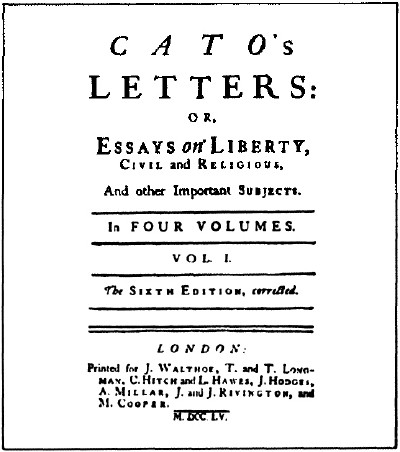
As I have stated many times in the blog, and as I try to explain in the book, the 'institutional theory' of credit markets is the cornerstone of Guillaume-Thomas Raynal's political economy. The idea is simple: without a rule of law, property rights are unstable and the supply of credit contracts, thus leading to high interest rates and to low volumes of trade (and to very little innovation). But what are its origins? Prior to my 'discovery' of François Bernier, I had always thought that John Trenchard and  Thomas Gordon, the authors of Cato's Letters, had pioneered the link between governance and credit that Montesquieu and others subsequently took up.

But I changed my mind last week. By pure coincidence, I came across the article "Liberté politique" in volume 23 of M. Robinet's Dictionnaire universel des sciences morale, économique, politique et diplomatique; ou Bibliothèque de l'homme-d'état et du citoyen, 1782 (pp. 208-226). It contains the very interesting Réfléxions d'un Anglois sur la nature, l'étendue & les avantages de la Liberté civile, a translation of Cato's Letter No. 67, published on February 24, 1721. It turns out that Trenchard and Gordon derive their ideas from ... François Bernier! (*)

* * *

Obviously, I hadn't noticed that when I first read No. 67. In Vol. II of the 1723 edition of Cato's Letters, the Frenchman is introduced as "the great and judicious traveller Monsieur Tavernier" (p. 143). The mistake is corrected in subsequent editions. To their credit, Gordon and Trenchard provide a "summary Account" of the last chapter of the History of the Great Mogul (the "Lettre à Monseigneur Colbert", which I plan to publish in the blog). I am beginning to suspect that Histoire des deux Indes owes much to Trenchard and Gordon and their fine reworking of Bernier. Here are the relevant passages:

There People will dare to own their being rich; there will be most People bred up to Trade, and Trade and traders will be most respected; and there the Interest of Money will be lower, and the Security of possessing it greater, than it ever can be in Tyrannical Governments, where Life and Property and all Things must depend upon the Humour of a Prince, the Caprice of a Minister, or the Demand of a Harlot. Under those Governments few People can have Money, and they that have must lock it up, or bury it to keep it; and dare not engage in large Designs, when the Advantages may be reaped by their rapacious Governors, or given up by them in a senseless and wicked Treaty: Besides, such Governors condemn Trade and Artificers; and only Men of the Sword, who have an Interest incompatible with Trade, are encouraged by them.

For these Reasons, Trade cannot be carried on so cheap as in free Countries; and whoever supplies the Commodity cheapest, will command the Market. In free Countries, Men bring out their Money for their Use, Pleasure, and Profit, and think of all Ways to employ it for their Interest and Advantage. New Projects are every day invented, new Trades searched after, new Manufactures set up; and when Tradesmen have nothing to fear but from those whom they trust, Credit will run high, and they will venture in Trade for many times as much as they are worth: But in arbitrary Countries, Men in Trade are every moment liable to be undone, without the Guilt of Sea or Wind, without the folly or treachery of their Correspondents, or their own want of Care or Industry [...].

Here's the French version. Note the term grandes entreprises, often used by Raynal and Diderot (HDI 1780, x.10; xiii.8; xvii.8; xvii.30):

C'est là que les habitans oseront se vanter de leurs richesses ; c'est là qu'on formera la jeunesse au commerce ; & que le négoce & les négocians seront en honneur ; c'est là que les intérêts de l'argent seront plus bas, parce que chaque particulier jouira d'une plus grande sureté dans ses possessions ; au-lieu que dans les Etats tyranniques, la vie, la propriété des sujets, toutes choses, en un mot, dépendent de l'humeur d'un prince, du caprice d'un ministre ou de la demande d'une courtisane. Sous ces gouvernemens, il est rare que le peuple ait de l'argent, & ceux qui en ont ne le perdent jamais de vue, ou l'ensevelissent afin de le mieux garder ; on ne forme pas de grandes entreprises, sur-tout quand on se doute que les avantages qu'on en retireroit pourroit exciter la rapacité des gouverneurs ; ou que l'on prévoit qu'ils n'auroient nul égard à la sainteté des traités. Il n'est que trop ordinaire d'ailleurs, que les gouverneurs ayent du mépris pour les commerçans & les artistes.

On ne considère que les hommes d'épée, dont l'intérêt est incompatible avec le commerce. C'est pour ces raisons que les négocians ne s'appliquent point à leur métier avec autant de satisfaction que dans les pays libres. Dans les pays libres, on dépense son argent pour son usage, son plaisir ou son profit. On cherche tous les moyens de l'employer utilement & à son avantage. On invente chaque jour de nouveaux projets ; on imagine de nouvelles branches de commerce ; on établit de nouvelles manufactures. Quand les commerçans n'ont rien à craindre, si ce n'est de la part de ceux à qui ils confient leurs marchandises, le crédit ne peut manquer d'aller haut ; & chacun tâchera de se maintenir dans le commerce aussi long-temps qu'il le pourra. Mais dans un gouvernement arbitraire, le commerce est sujet à des révolutions bien plus dangereuses que la mer & les tempêtes. Sans rien craindre de leur correspondans, les négocians ne seront jamais certains de recueillir le fruit de leurs veilles & de leurs soins, ni l'artisan celui de son industrie.

(*) John Dryden's Restoration drama Aureng-zebe (1675) did much to promote Bernier's popularity in England.
________________

Tuesday, June 26, 2012

THE GENIUS OF FRANÇOIS BERNIER (I)
"...une authorité comme absoluë" — François Bernier

AM | @HDI1780

I just re-read the last 30 pages of Vol. 1 of Paul Maret's magnificent edition of Voyages de François Bernier. Contenant la Description des Etats du Grand Mogol de l'Hindoustan, du Royaume de Cachemire, &c (Amsterdam, 1699) [see]. This fantastic book is the key source of many important ideas of Montesquieu, Raynal, Diderot, Adam Smith and Volney. The more I read Bernier, the more I am convinced of this fact. So let me first lay down some points of reference about Bernier and Histoire des deux Indes.

The key idea here is the notion of "le Mien & le Tien", Bernier's peculiar way of describing the fragility of property rights across the Eastern world: "Ces trois Etats Turquie, Perse, & l'Hindoustan, ...ont tous osté ce Mien & ce Tien à l'esgard des fonds de terre & de la proprieté des possessions" (p. 310 bis). Without citing the adventurous traveler, Raynal mentions this idea in Book X: "César trouva dans les Gaules le même usage qui porte le double caractère, d’un état primitif où tout étoit à tous, & d’une condition postérieure, où la notion du tien & du mien étoit connue & respectée" (HDI 1780, x.8).

* * *

While looking for more textual references with the help of Google Books, I suddenly realized that Raynal and Diderot had merely transposed —sometimes word by word—, Bernier's ideas on the governance of the "Hindoustan" to the French colonies in the Caribbean and North America. Thus Bernier states that the Moghol's governors act "comme de petits Tyrans avec une authorité sans bornes"; this is exactly how Raynal describes the lieutenant du roi in French Antilles: "C’étoit un petit tyran, qui vexoit les cultivateurs, qui rançonnoit le commerce & qui aimoit mieux vendre un pardon, que prévenir des fautes" (HDI 1780, xiii.57).

And the phrase autorité sans bornes shows up on many occasions in HDI: xiv.2, xviii.19, xviii.35, xix.2. In the process of adapting Bernier's account to the New World, Raynal and Diderot came up with two very important ideas that figure prominently in Histoire des deux Indes: the impact of the governance structure on the supply of credit, and the fragility of forme judiciaire in the periphery of the empire. (And I have yet to re-read the parts on trade!). I will come back to these two points in the coming days. Stay tuned for more about the genius of François Bernier.
________________

Monday, June 25, 2012

ON CREDIT MARKETS, ONCE AGAIN...
"...on prêteroit avec plus de confiance" — Diderot  

AM | @HDI1780

I have found yet another reference to what I call the 'institutional' theory of credit markets, very popular throughout the Eighteenth century. It occurs in article ARGENT, published in 1778 in volume 6 of M. Robinet's Dictionnaire universel des sciences morale, économique, politique et diplomatique; ou Bibliothèque de l'homme-d'état et du citoyen (page 88). Here's the relevant passage:

Ce que j'avance à ce sujet est si vrai, que j'ose soutenir qu'on ne trouvera aucun pays où l'industrie regne, & où la bonne foi soit respectée dans lequel l'intérêt l'Argent soit haut; & au contraire, partout où l'on paye un gros intérêt, la reproduction annuelle est languissante, & la fidélité des contrats est suspecte; on peut donc calculer la félicité des Etats d'après le taux d'intérêt qu'on y paye pour l'Argent prêté.

The language is strikingly similar to that used by Raynal, Diderot, and others who wrote about credit markets at that time. Thus when French colonists default on their debts, Raynal calls it "une infidélité des plus criminelles" (HDI 1780, xiv.40), while his colleague Diderot calls for more "bonne foi" and "fidélité dans les engagements" as a way to prop up confidence (HDI 1780, xii.31). If lending were to be completely prohibited in the colonies, warns Raynal in a key chapter on credit, it would surely lead to "opérations de jour en jour plus languissantes" (HDI 1780, xiii.54) (*).

(*) Turgot, an important source of Raynal and Diderot, also uses "infidélité", "bonne foi" and "languir" in the context of a default on debt obligations. Œuvres de Mr. Turgot, Tome V. Paris: Delange, 1808. And let's not forget Adam Smith's poignant observation: "Interest is raised by defective enforcement of contracts".
________________

Thursday, May 31, 2012

VOLNEY TO JEFFERSON ON CREDIT MARKETS
"Aequitas, aequilibrium, aequalitas, sont tous de la même famille" — Volney

AM | @HDI1780

Writing from Philadelphia in January 1796, Volney tells Thomas Jefferson that "Le Systeme de Notre gouvernement est different de celui qu'il etait il y a un an". For the first time in French history, the 1795 Constitution embraces bicameralism. Later that year, again from Philadelphia, an ecstatic Volney describes the sea-change in credit market conditions: "... nos affaires intérieures Vont bien, la Valeur de Nos biens fonds a doublé en Numéraire en 3 Mois: l'on Vend à terme de 90 jours, chose inouïe depuis 3 ans".

In other words: bond prices have doubled, confidence has soared, and credit now flows normally throughout the economy. From a credit market perspective, the Robespierre years were indeed dreadful. What I like about Volney's letter is the implicit link between governance and ... interest rates. Good governance brings about increasing levels of confidence and credit; tyranny destroys them. This is one of the key lessons of Histoire des deux Indes, a book that Volney read with passion.

(*) The Papers of Thomas Jefferson, Vol. 29. Princeton University Press, 2002.
______________

Monday, May 28, 2012

UNE POSSESSION PRÉCAIRE
"... sans risque & sans inquiétude de leurs possessions..." — Raynal

AM | @HDI1780

Quel est le mot qui revient le plus souvent dans l'Histoire des deux Indes? Voici une possibilité: possession, possessions. Sans compter le verbe posséder, ce mot est repris 219 fois entre les Livres X et XIX. Quelques exemples: "Que possède celui qui a renoncé à toute possession?" (1780, xi.24); "...possession de leur conquête" (1780, xv.7); "...possession des pelleteries..." (1780, xv.10); "On prit possession de la colonie au nom de son nouveau maître..." (1780, xvi.11); "Une loi du 14 janvier 1778, assure aux possesseurs la propriété de ce qui se trouvera dans leurs mains" (1780, xii.7); "Une possession si précieuse..." (1780, xvi.20). Etc, etc.

* * *

Pour bien saisir l'importance des idées de possession et de propriété, il faut relire les textes de Raynal et Diderot sur les taux d'intérêt. L'Histoire des deux Indes reprend l'idée de Montesquieu: plus les possessions sont précaires, plus l'offre de crédit se rétrécit — et plus les taux d'intérêt sont élevés (*). Or, la fragilité des possessions est le trait caractéristique du gouvernement despotique; c'est précisemment le cas des colonies françaises d'outre-Atlantique: 

Les gouverneurs & les intendans accordent en commun les terres qui n’ont pas été données, & jugeoient, il n’y a que peu d’années, de tous les différends qui s’élevoient au sujet des anciennes possessions. Cet arrangement mettoit dans leurs mains, dans celles de leurs commis ou de leurs créatures, la fortune de tous les colons; & dès-lors rendoit précaire le sort de toutes les propriétés. On ne sauroit imaginer un plus grand désordre. (1780, xiii.56).

Quand le pouvoir éxécutif fait main basse sur l'activité des juges, les possessions et les propriétés deviennent précaires; le crédit disparaît. Montesquieu l'affirme à propos de la Turquie, où les biens "sont possédés d'une manière précaire" (EL, V.14). Ce texte précède de très peu le remarquable chapitre de l'Esprit des lois sur la relation entre despotisme et ... usure.

(*) Dans les temps d'anarchie, cela va sans dire, la propriété est fragilisée. Voici Raynal à propos de la chute de l'empire romain: "Tous les possesseurs de fiefs prétendirent, dans ces tems d’anarchie, qu’un roturier, quel qu’il fût, ne pouvoit avoir que des propriétés précaires, & qui venoient originairement de leur libéralité" (1780, xi.24). Là aussi, les taux d'intéret seront particulièrement élevés: voir. À noter, à ce propos, ces lignes de Turgot: "Les uns ont fait ce marché pour un tems, et n'ont laissé à leurs Serfs, qu'une possession précaire et révocable" (Réfléxions sur la formation et la distribution des richesses, XXVI).
_____________